Sunday, 13 May 2012

Wards Estate - Part 2

There was a comment on a previous post querying why the RSPB needed to raise funds to buy the Wards Estate when it is already covered by a number of protective designations. I took this up with RSPB who have given this response.
"The site is indeed covered by a number of natural heritage designations (NNR, SSSI, SAC, SPA).  These help to protect the site from damaging development or activities.  They do not, however, guarantee that the site will be managed in the best way or that we make the most of opportunities for the public to enjoy it.  This partnership will safeguard the wildlife and precious habitats on this site for at least another 25 years. Had SNH and the Park chosen not to provide funding, it is likely that RSPB would not have proceeded and the site may have been purchased by a private owner unwilling to work in partnership with SNH and the Park Authority"

This is an impressive array of letters which led me to try to find out a bit more about what they mean. Here is a summary but a lot more detailed information on protective designations can be found on SNH's website
NNR - National Nature Reserve. National Nature Reserves are areas of land set aside for nature, where the main purpose of management is the conservation of habitats and species of national and international significance. Visitors are welcome at National Nature Reserves.


SSSI - Site of Special Scientific Interest.  Sites of Special Scientific Interest (SSSI) are those areas of land and water (to the seaward limits of local authority areas) that Scottish Natural Heritage (SNH) considers to best represent our natural heritage - its diversity of plants, animals and habitats, rocks and landforms, or a combinations of such natural features. 


SAC - Special Area of Conservation.  This is an international designation and recognises the importance of a site that extends beyond national boundaries.  A Special Area of Conservation (or SAC) is a site designated under the Habitats Directive. These sites are called Natura sites and they are internationally important for threatened habitats and species. Natura sites form a unique network of protected areas which stretches across Europe from the rocky coasts of Ireland in the west, to the marshes of eastern Poland, taking in the northern forests of Sweden and the volcanic lava fields of Tenerife. SACs are selected for a number of habitats and species.
SPA - Special Protection Area.  Another international designation. A Special Protection Area (or SPA) is a site designated under the Birds DirectiveSPAs are selected for a number of rare, threatened or vulnerable bird species listed in Annex I of the Birds Directive, and also for regularly occurring migratory species.


RAMSAR.  RSPB didn't mention this but this is also an important international designation.  What does Ramsar stand for? It's actually the name of a town in Iran where the Convention of Wetlands of International Importance was adopted in 1971. The UK Government signed up to the Convention in 1976.  The mission of the Convention is "the conservation and wise use of wetlands by national action and international cooperation as a means to achieving sustainable development throughout the world".


This emphasises yet again what a very special place this is and makes me appreciate even more how lucky I am to be able to enjoy the wonders of this area on a daily basis.

Thursday, 10 May 2012

It must be summer - at last

For the past week there has been a solitary swallow seen occasionally over the fields towards the loch - and, as we all know, one swallow doesn't make a summer.  However, today they were back in force, several of them swooping and soaring around the gable end of the house.  We have been on the lookout for them for almost a month.  They are usually here by the middle of April and have been very late in making an appearance this year.  Maybe the kink in the jet stream sent them off course and they have struggled to make their way back  There are plenty of flies and insects for them to feed on as the midge season seems to have started early this year - despite the rain and chilly weather.  It really is good to see their return. [The swallows that is - definitely not the midges except insofar as they are food for the swallows.  Pity you can't have one without the other.]  Now all we need is some sun.
The news of RSPBs imminent arrival in the area must be spreading through the avian world as I have sighted three species this week that I have not seen before.  Just as I was approaching Shore Wood yesterday a small bird darting through the trees and eating buds caught my eye.  It was a blackcap and I was able to watch it for several minutes before it flew higher and out of sight. As I went through the last gate to cross the short stretch of open ground before the Net Bay View Point there was a bird making very shrill call at the waters edge.  I did not get a chance to watch them for long because they darted away but there was a pair of ringed plovers at the waters edge.  The final new sighting was this afternoon, right outside the sitting room window.  A small green bird landed on the table outside and I got a clear view of a dainty little goldcrest.  This is certainly a first in the garden and I will certainly be looking out for it again.


The range of wild flowers in bloom along the path seems to increase by the day. As we go into May the bluebells are at their best.


Tuesday, 24 April 2012

Endrick Marshes in safe hands


Fantastic news!  The Wards Estate has been purchased by a partnership between RSPB, Scottish Natural Heritage and the Loch Lomond and Trossachs National Park to be developed as a nature reserve and bird sanctuary.  The diverse wildlife of this unique area will be safe and encouraged to prosper here.  This is a very special area that is significant internationally as well as in Scotland and Britain.
High Wards Farm has also been purchased and will become the base for RSPB staff who will be managing and developing the site.  Over time a visitor centre will be created and access to the area improved whilst maintaining the security and wellbeing of the wildlife.
This is a very exciting prospect for the area and those of us who enjoy the woods on a daily basis.  RSPB are keen to work with the local community as the project develops.  However, there is also an Appeal to raise the £1.1m needed to complete the purchase.  Donations can be made online at RSPB Wards Estate Appeal


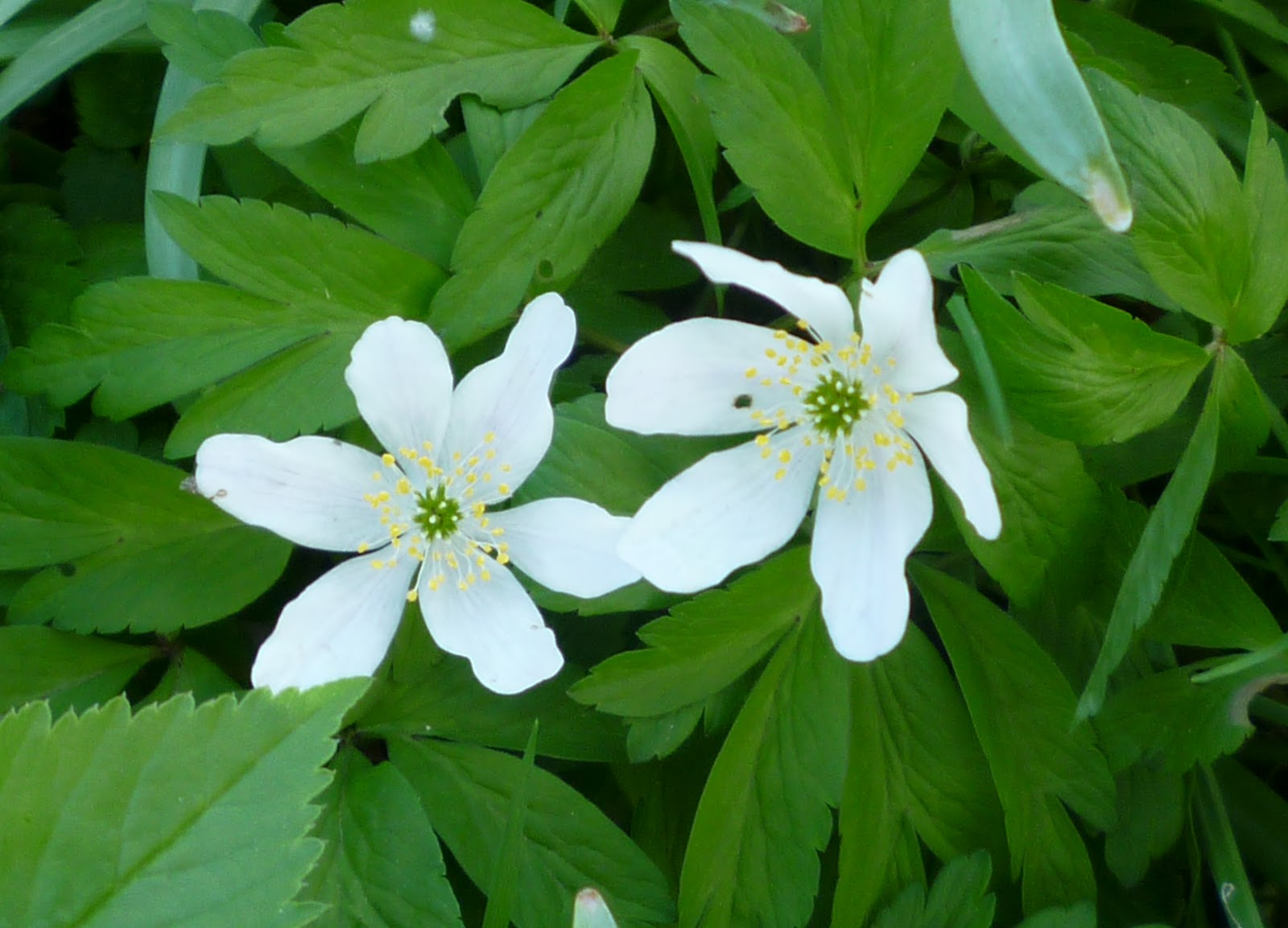
Shore Wood is recovering from the long winter and there are definite signs of Spring.  It's too early for the bluebells to be out in force although there is the odd hardy specimen.  It is the wood anemones that are a delight and I would urge you to go and see them.  Their dainty star like faces follow the sun as it penetrates the still bare branches.  A carpet of stars.


Sunday, 29 May 2011

Back Again

I know, I know, it's been a very long time since my last posting - over six months.  Mobility problems mean that I have not been getting down to the loch as often as I would like.  In fact hardly at all.  However, in a couple of weeks time I am due to get a new knee and after being off my feet for a few weeks should be back to normal.  I will try to do some catching up while I recuperate.


The big news of the past week has been Monday's storm.  It was certainly the worst I have known since I have been here and this has been echoed by many locals too.  We were without power for nearly 48 hours while fallen cables were being located and restored.  The garden was hit hard.  A sixty foot oak tree (above) lies across the lawn and an old rowan tree also toppled.  Branches are everywhere and clearing up will take quite a time.  However, there are plenty of volunteers just dying to get out their chainsaws.  The winds are still strong and it may be sometime before I can get a bonfire lit to clear away some of the wood that is not much use for firewood or kindling.  At least we will be warm for the next couple of winters.  There's a couple of tons of good oak wood for the fires.

Thursday, 28 October 2010

Autumn Reflections

A Carpet of fallen leaves

The signs of Autumn are all around.  There is a definite chill in the air and the night-time frosts over the past week have brought more and more colour to the landscape.  The trees are glowing with gold and red and russet hues.  Even the drive to Balloch today was through arches of yellow and brown.

This weekend the clocks go back and although we will be glad of the light in the early mornings, it will certainly be dark by tea time.  Halloween this weekend and then Bonfire Night - at least there are plenty of opportunities to brighten the darker evenings.  The shorter days mean that we have to make the most of what daylight there is and there are still apples on the tree waiting to be picked.  It has been a bumper crop everywhere this year and our apple tree which has previously produced less than a dozen rather wizened specimens is this year laden with fruit with boughs bent over and touching the ground.  The apples are small but sweet and will come in useful in pies, cakes, crumbles and chutneys, as have all the others generously given by neighbours.  All this fruit in gardens and hedgerows is not necessarily an indicator of a hard winter ahead - but of the mild Spring we had this year which allowed all the blossom to set.


There have been some magnificent fungi in the garden and woods - far more than I have been able to identify.  Here are a few of the finer examples A giant puffball the size of a football, a magnificent Fly Agaric and A pebble fungus - well named as is hides in the path.

The other indicator that winter is approaching is the loss of the cattle from the fields.  Today has been the day when Coopers lorry has trundled up and down the lane to fetch the cows to their winter quarters in the steading.  They don't sound too happy as they go past but no doubt will appreciate the warmth and security of their indoor winter home.  We miss seeing them in the fields all around us but will probably get a chance to visit them later in the year when they are settled in.  Every year there are calves born in the steading who first experience the joy of the meadow when they emerge again in Spring.

There is something about the 'transition' seasons - Spring and Autumn - that is quite magical.  There are changes every day and I look forward to cosy nights by the fire and the Christmas lights ahead.  


Thursday, 23 September 2010

The Aber Yew

On the walk to the loch the other morning I noticed a number of yew seeds that had fallen from this old yew.  The yew is a very slow growing tree and this one is reputed to be several hundred years old.  The leaflet on the Aber path tells the story associated with the tree and describes how the yew tree was a gathering point for the cattle that were once an important part of life in the township. 


"Glens near the north of Loch Lomond were home to two clans - the Macfarlanes and the Macgregors - who were keen cattle rustlers. Whenever livestock was stolen, the local landowner had to pay his tenants for their losses. Tiring of this expense, William Cochrane of Kilmaronock signed-over the local farmlands to his tenants in the late 1600s, in return for modest payment. Once the small farmers (all of whom were fairly poor) owned the land, the cattle raids stopped!

For more than a century after that, the ‘Aber Lairds’, as the small farmers were 
known, worked the land around here. Each morning, a herdsman would blow a horn beside the yew to muster the Aber cattle. Then he’d take them to the common 
grazings on the Ring, close to the eastern end of this walk. In the evening, more 
blasts of the horn would summon the Aber folk to collect their livestock." 

This history makes it all the more distressing to see the old tree dying.  However, the fact that it has still managed to produce some seeds provides an opportunity for it to continue.  I collected several of the seeds with their fleshy red aril and have been researching the best way to propagate them.  It could take some time as yew seeds can take up to two years to germinate.  Firstly I need to simulate the stomach of a thrush or blackbird and provide some warm damp conditions for a few weeks. Then a harsh winter needs to be created as they go into the bottom of the fridge.  This may need to be repeated if nothing happens next spring.  I just hope I've got the patience and don't forget about them.  I'll report back in a couple of years to see if any of the seeds have sprouted.  Their slow growing nature means that it could be another thirty years before any new plant produces its own seeds.  Definitely a project for the long term.

Sunday, 19 September 2010

Happy Brambling


I find the lure of the bramble irresistible and this has been a very good year for blackberries.  The hedgerows are laden with plump purple berries.  The rewards are worth the trials - the scratched hands and stained fingers.
As if the prickles of the bramble weren't weapon enough to deter the picker, they also manage to grow amidst a host of the other well-armed plants.  There is a magnificent crop along the short cut up to the Hall but you need to be well protected.  I fought my way through nettles, hawthorn, dog roses, gorse, thistles and holly to reach the best berries.  This is where a stick comes in handy; although I found the Leki pole not nearly as effective as the old fashioned walking stick with the curved handle for grabbing that best spray of fruit that always seems to be just out of reach.
Once home the brambles have quickly been converted into jelly and blackberry and apple tarts.  I experimented this year and made some little filo tarts in muffin tins.  


Each sheet of filo pastry was cut into four and then two small sheets placed into the muffin tin at an angle to each other.  Layers of apple, blackberries were added with a little sugar (or granulated sweetener) between each layer.  Baked in a hot oven for about ten minutes they were delicious with a small dollop of creme fraiche or ice cream.  This batch didn't last long.
The first batch of jelly that I made was with pure blackberry juice but with the second batch I followed the recipe form the Glasgow Cookbook which includes apples with the berries.  I think I prefer the intensity of flavour of the pure bramble jelly.  It takes me back to my childhood and I still find hot buttered toast with bramble jelly one of life's pleasures.

Friday, 11 June 2010

Springwatch comes to Aber


There is new life everywhere. This wee calf getting a reassuring lick from its Mum is less than an hour old. There was a knock on the back door a couple of nights ago and it was the local farmer telling us of the new arrival. The cow had just given birth in one of the fields towards the loch. We hurried down to see her and after tramping across a couple of fields came upon the mother and her new offspring. Although the calf could just about stand up and walk it was still very wobbly and still didn't quite have full control of its legs.

All round the garden and along the lanes there are families of fledgelings still waiting to be fed by their parents. We followed the efforts of a pair of very hard working blue tits who reared a family in a bird box just by the sitting room window. Unfortunately we missed the day they actually left the nest and we hope they made their first flight safely. There are so many predators around that not all will survive. Driving home today we startled a buzzard who was feeding on a gatepost by the Guide Camp field. It had just caught a young rabbit. It struggled to fly away and skimmed low over the bushes. The rabbit must have been quite a weight and its legs were dangling as the buzzard flew away with it, no doubt taking it back to its own nest of hungry youngsters.

It was very peaceful down at the loch this evening. There were ducks and ducklings, geese and goslings and a grebe and - not sure what a young grebe is called so I think I'll call it a gribling. The raucous laughing call of the shelducks was carrying across the still water. Breaks in the clouds allowed light to stream on to the hills in the distance - idyllic.


Thursday, 1 April 2010

Man made changes.


1st April 2010


12th May 2009

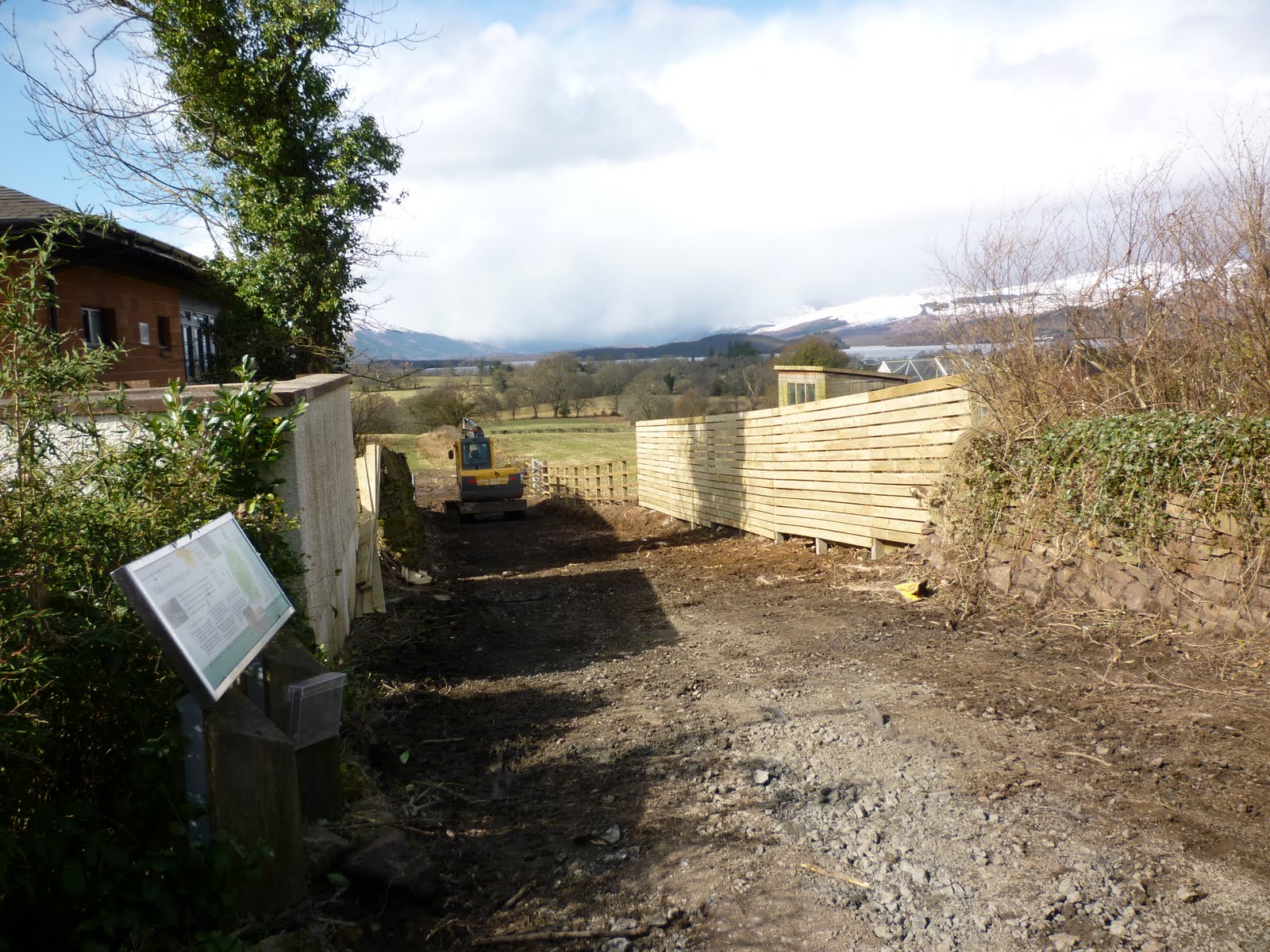
What a difference a year can make. When this first photo was taken last May, the part of the Aber Path by the Millennium Hall down to the 'shortcut' was a pleasant footpath with a canopy of trees - a shady start to the walk down to the Loch. When I walked up there today it has become a highway for diggers with caterpillar tractor wheels tearing up the path. The trees have been cut back and completely removed and along with them the ancient stone wall which has been replaced by a wooden fence.

So sad to see the countryside spoiled like this. Farm vehicle access to the field was possible from the other fields around and certainly at present access for walkers is extremely difficult. Boots are essential and be prepared to get bogged down in places. At the very top by the gates (which have been moved around to make way for the heavy earth moving equipment) the only safe path is along by the hedge. As this area is outside the 'village envelope' and therefore will not be considered by planning authorities for housing development, it is difficult to see what the changes can achieve.

The layout and pattern of fields is very much a part of the local heritage and needs to be respected and preserved. This is very clearly demonstrated in the leaflet that Scottish Natural Heritage produced to enable people to appreciate the Aber Path and learn about what can be seen along the way. This shows how the pattern of fields has changed hardly at all since they were marked on a map in 1865 and are still recognisable from the air today. At last month's heritage group meeting, a copy of this amazing map which forms a book of maps and which covers the whole of the Parish of Kilmaronock was available for inspection. It is a sizeable tome and when opened out would cover a table that could comfortably seat four for a meal (once the map had been removed of course).

Any regular readers of this blog will notice that I have also made a few changes to design and layout which I hope you find pleasing. It keeps me amused to play around with all the various tools that are provided by Blogger.

Monday, 22 March 2010

Phenology - what this blog is all about.

This fine figure of a frog emerged from under the damp undergrowth as I was clearing up the garden on Saturday. It was good to get out and enjoy the milder sunnier weather and I think the frog felt the same. I suspect that it is a female full of eggs. There is very little water around for her to lay them in although I took her down to the pond and ditch and hope that the rain will help provide the environment she needs.

The loch is beginning to fill again and return to more normal levels as the snow gradually melts from the hills and mountains. The Campsies are nearly snow free now although there is still quite a lot lying in the gullies on the higher slopes.

It's strange how a word that you have never been aware of before sometimes crops up all over the place. In last month's Dumpling Times I noticed that the Park Rangers are working with children on a phenology project. I had never come across the word 'phenology' before but as the article explained it is the study of seasonal or cyclic changes, particularly in relation to climate, animals and plants.

After giving a talk about this blog at the local heritage group (on the basis that any record or diary kept now may become an archive in the future) a neighbour mentioned to me that the Woodland Trust undertake a national phenological survey that I might be interested in. As one of my reasons for writing this blog was to record changes it seemed a good idea to follow this up. Now that I have registered, observations I make can be recorded online at the Nature's Calendar site where it is also possible to see how Spring (when it finally arrives) advances from South to North across the UK. A very useful booklet gives guidelines on what to record and how to ensure that all observations are made when trees and flowers are at the same stage of development for consistency across the country. This will give me a new purpose when I am out and about - looking for budburst, full leaf and flowers in oaks, elms, and alders as well as recording the wildflowers.

These are still very late this year. There is just one clump of daffodils out by the post box brightening up everyone's day as they drive past. This little group is always ahead of all the others but is even earlier this year. They may be a particularly early variety but they are also in a very sunny and sheltered spot. In the woods and under the hedges, there are signs of some of the leaf shoots of the bluebells and wild garlic. A few more warm days is what we all need!

Tuesday, 16 March 2010

Can Spring be far away?


This has certainly been a hard winter - and also a long one. Although we are well into March and Mother's day has come and gone the daffodils are still struggling to appear. It feels as though we are waiting a long time for Spring to come

These photos show how much later everything is this year. The snowdrops that line the path down to the loch are beautiful every year. The photo on the left was taken on February 21st 2009 whilst the one on the right taken last weekend - March 14th 2010. As you can see they seem to be at much the same stage of development - just three weeks later this year. They were certainly late to appear as the ground was covered with snow throughout most of January when they generally first appear. Then, the harsh frosts of the last few weeks have battered them down every morning although they revived again in the sunshine later in the day.

It is not just Aber that is affected of course. The Woodland Trust reports that sightings of Spring Flowers are a month later this year than average. It will be interesting to see what impact this has on other species as the year unfolds.

The rest of the walk is unremittingly brown and bare. The dead grass has been flattened by snow and the trees are bare with no buds showing yet. The only hint of better times to come was the change in wind direction. After weeks of bitter easterlies it has begun to turn and was coming from the north west again and blowing the waves into Net Bay.
The quality of light has changed however and with nights and days being of almost equal length as the equinox approaches, spirits are lifted.


Tuesday, 2 March 2010

A Blog from the Bog

The village website (www.gartocharn.org) has been full of photos showing the snow-covered mountains and frosted trees and plants. Although the cold weather is back again with the easterlys blowing into the front door there have been a couple of days of relative thaw. The ground has not been quite as hard and after the snow the fields have been wet and boggy on top but still quite firm beneath which has made for easier walking to parts of the reserve I don't usually reach.


On the walk through Shore Wood to Net Bay there was a sudden whoosh and roar that preceded the raucous honking as a flock of
Canada and Greylag geese were disturbed on Lime Hill Field and all took to flight together. This is a favourite feeding ground for geese and there must have been two or three hundred in the cloud that flew over my head towards Ring Point at the mouth of the Endrick. We went on to Net Bay and observed how low the loch is still. Even after the snow the level hasn't risen much but that is probably dependent on the thaw that has yet to come.


After disturbing a heron, Rosie discovered she could walk on water. There was still thick ice at the base of the channels but these had thawed on top and then refrozen with a thin layer of ice on the surface. This meant that she could run and slide across the surface which she did very excitedly. It is going to be a long time until the ice fully disperses where it is so thick and hard.

We looked out for otters as there was evidence from the spraints (droppings) that we found that this was part of their territory. I guess that the ice will have forced them into the Endrick and the loch to search for food.

Although the signs of Spring are very hard to find, (the poor snowdrops that were delayed by the thick January snow get knocked back every night with the hard frosts but revive when bathed in what little sunshine there is) the last couple of days have felt spring like and it's hard to figure out why. Everything in the wood is grey and brown, the bracken flattened and no signs of green shoots yet. However, the quality of light seems somehow different which lifts the spirits and makes me feel that it will not be long until the telltale signs appear. All we need is a few warm days.

Monday, 30 November 2009

High Water at Net Bay

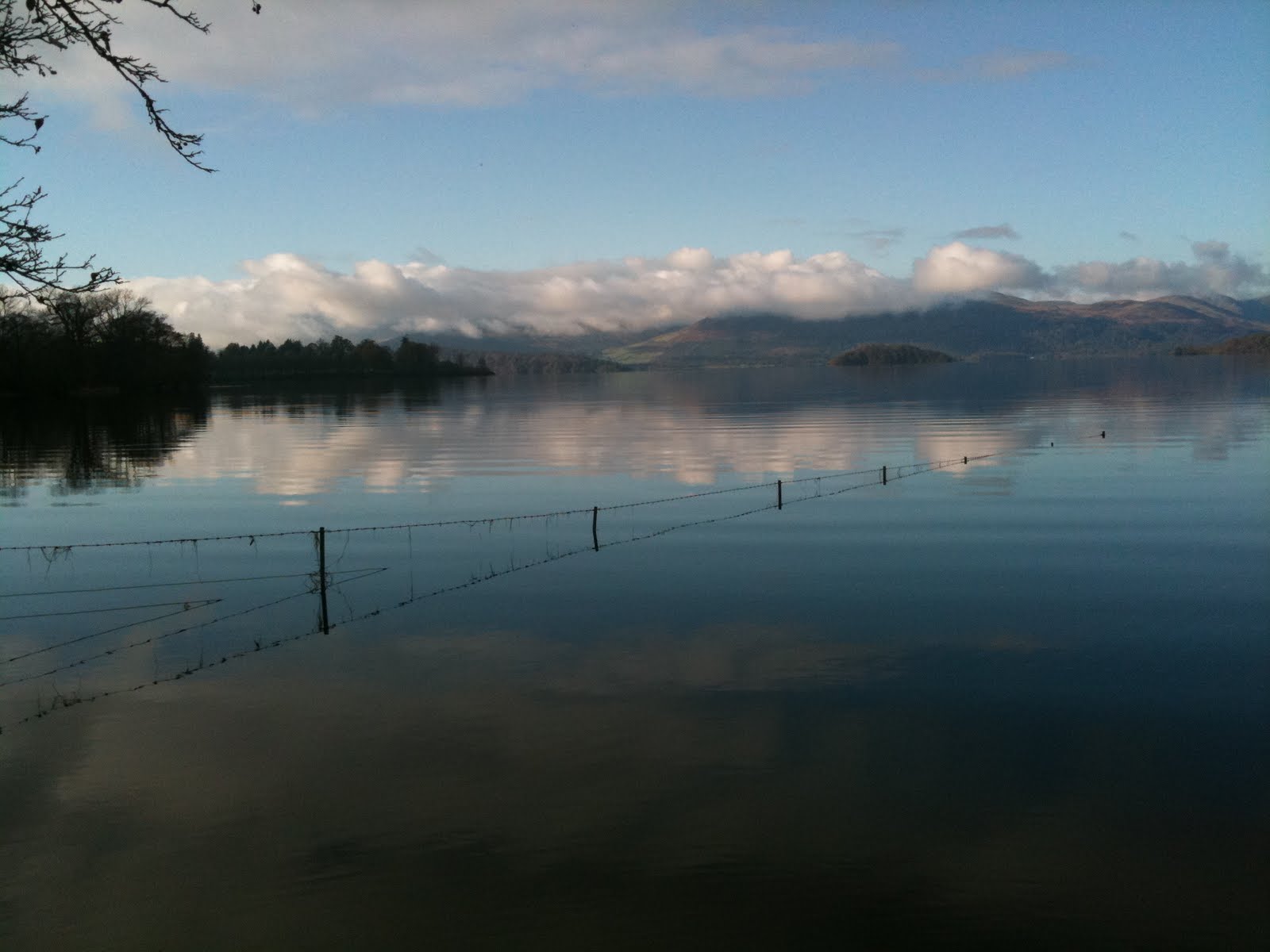
The new main photo gives an idea of how much higher the loch is since the recent storms and heavy rainfall. Today however has been bright and clear with the temperature barely rising above freezing all day. Winter at last and nobody minds on days like today when everything is fresh and sharp.

There was a rosy tinge to the mountains this morning - those without the topping of snow that is - with dark
reflections in the water.

The storms also brought a new sight in the bay. A mooring had obviously come adrift from one of the marinas and drifted into the shallows. It can just be seen in this photo with a bit of a list!

Friday, 27 November 2009

Welly and waterproof weather!


I know, I know, we haven't seen much blue sky over the past month - just lots and lots of rain. The loch is really high again - up to the seat at the viewpoint - and looking across from the high point on Ross Loan to where the Endrick flows into the loch, Ring Point (the thin strip of land between the river and the loch) is completely submerged. There is water in the fields all round Wards and the garden is sodden.

Roads have been flooded in all directions and a few nights ago I just missed running over a frog who was in his element as he hopped across a road that was running like a stream. Most days however, it has been possible to dodge the showers although on occasions Rosie and I have both come back from the daily walk absolutely drenched. With the skies so overcast it is also the lack of light that is noticeable. It was dark by half past three one day this week. However, the walk through Shore Wood is more open and airy in winter than in summer as the bare branches allow much more light through.

Although it feels as though the full force of winter has yet to strike, with fairly mild temperatures and very little frost so far, ironically the first signs of Spring are appearing. On the walk to the loch, the pale green spikes of the snowdrops are beginning to burst through and some of the daffodils are also beginning to show. They must be encouraged by the mild weather but no doubt growth will slow again once the really cold weather comes.


Sunday, 8 November 2009

First Frost

It was a bright crisp morning and the fields all around were sparkling white when I drew back the curtains this morning. Definitely no time to lose to make sure we were down to the loch before the sun had melted the ice and dissipated the magic.

Wrapped up warmly with hat and gloves for the first time this winter and set off briskly. We were rewarded with a sight of the the first sprinkling of snow on Ben Lomond and the Arrochar Alps. The loch was calm and clear with geese honking, swans on the far side of Net Bay and a solitary heron fishing patiently over on Ring Point.

We decided to make our way to the Endrick Viewpoint further up the hill which is where this first picture was taken. The frost had not been hard enough to freeze the ground and it was pretty heavy going after all the rain and the trampling from the cattle. But by stepping carefully from tussock to tussock we managed not to lose a shoe. It would have been easier if we were in wellingtons. I managed with much less difficulty when I did the same walk last week more suitably clad. The gate was still glistening with ice crystals on the way up which had started to melt by the time we had squelched our way back down again.

The afternoon was spent collecting leaves for the compost. Even piled up wet and soggy in the wheelbarrow the colours were glowing. It really has been a wonderfully colourful Autumn this year.

Friday, 16 October 2009

A fantastic autumn day

Up early this morning and down to the loch at first light. There was a mist rising from the loch and the fields and wisps of cloud lingering in some of the glens. It was a truly magical morning and the light has been wonderful all day.


The woods are full of spiders that I've never seen but their presence can be felt by the fine filaments that brush against your face as you walk along the path. I imagine them as minute trapeze artists swinging from tree to tree only have their safety harnesses swept away as I walk through. The cold night had produced a touch of frost and heavy dew so there was clearer evidence of the spiders' activities this morning in the delicate webs,

Saturday, 3 October 2009

What a difference a day makes


From this -----------------------------------------------------------to this
in less than twenty four hours.

Friday night saw the wind getting up - so much so that one huge gust hit the gable end with such force that it woke us up. Unusually, this wind did not blow itself out in twelve hours but continued throughout Saturday. It was exhilirating walking through the woods and by the loch. Squalls of rain kept blowing over from the West with rainbows arching over the islands. I've seen the loch choppy before but never seen such spectacular waves rolling in. In the distance a fuzzy grey line between the water line and the shore indicated where the spray was being whipped from the tops of the waves. And the roaring of the wind in the treetops meant that it was almost impossible to carry out a conversation.

All along the path there were leaves, twigs and branches that had been blown down. As far as I could see there had been no major casualties but plenty of branches for Rosie to get her teeth into.

Today was much calmer although there were still a few ripples on the water and the occasional white horse. The sky was blue and the birds were singing again - the turmoil of yesterday already forgotten.

Thursday, 24 September 2009

Fly Agaric


Here is every child's image of a toadstool - the classic red with white spots. We have had lots of fly agaric on the garden this year and they reminded me of a poem my Mum used to recite to us as children - The Elf and the Dormouse by Oliver Herford, an American poet of the early twentieth century.

Under a toadstool crept a wee Elf,
Out of the rain to shelter himself.

Under the toadstool, sound asleep,
Sat a big Dormouse all in a heap.

Trembled the wee Elf, frightened and yet
Fearing to fly away lest he get wet.

To the next shelter—maybe a mile!
Sudden the wee Elf smiled a wee smile.

Tugged till the toadstool toppled in two.
Holding it over him, gaily he flew.

Soon he was safe home, dry as could be.
Soon woke the Dormouse—"Good gracious me!

"Where is my toadstool?" loud he lamented.
—And that's how umbrellas first were invented.

I am reminded of this little rhyme every time I see the large toadstools that have sprung up all over the garden this year.

Saturday, 5 September 2009

An early Autumn

Just a quick post - there's a lot happening and not much time for blogging.

The walk in the woods is getting wetter with the loch level really high for this time of year. The beaches have practically disappeared - much to Rosie's displeasure - and some of the trees already have their feet in water.

After weeks of seemingly unremitting rain there are occasional glimmers. I caught this pool of light on a walk last week. I love the spicy
smells of Autumn and the changing colours. The bracken is turning brown now and will soon be flattened by the winds and storms.

There are also signs of the swallows preparing to leave - lining up on the wires and taking part in spectacular feeding frenzies as they swoop and dive for insects. It's either that or they are in training for the marathon flight ahead.


Sunday, 23 August 2009

What a week!

This has probably been one of the wettest weeks of the summer. There have been several absolutely torrential downpours - one of the which sent the cows in the neighbouring field stampeding down to shelter under the trees at the furthest corner. It has been impossible to miss the showers when out walking Rosie and we have observed that the loch level has risen several feet and the beaches have now disappeared.

The woods are beginning to change with far fewer wild flowers in evidence and bracken and grasses turning brown. Even though it is still August there is a faint tinge of Autumn about, as colours change and berries begin to ripen. The storm-struck oak has now been felled and lies full length on the ground. It was considered too much of a risk to leave it to age and fall naturally, possibly across the path or destroying the nearby fence. The size of the split shows how much damage was done by the lightening. It will now be left to decay naturally and provide a micro-habitat for wildlife and fungi. From the number of rings on the trunk this oak had already lived to a good age - at least 60 years if not longer.


A sure sign that Autumn is coming is the number of mushrooms and other fungi springing up throughout the reserve - and in the garden. Here are a couple from the garden - a giant puffball measuring at least 10 inches in diameter and some that I think are common earth balls.